Da Vinci’s True Masterpiece

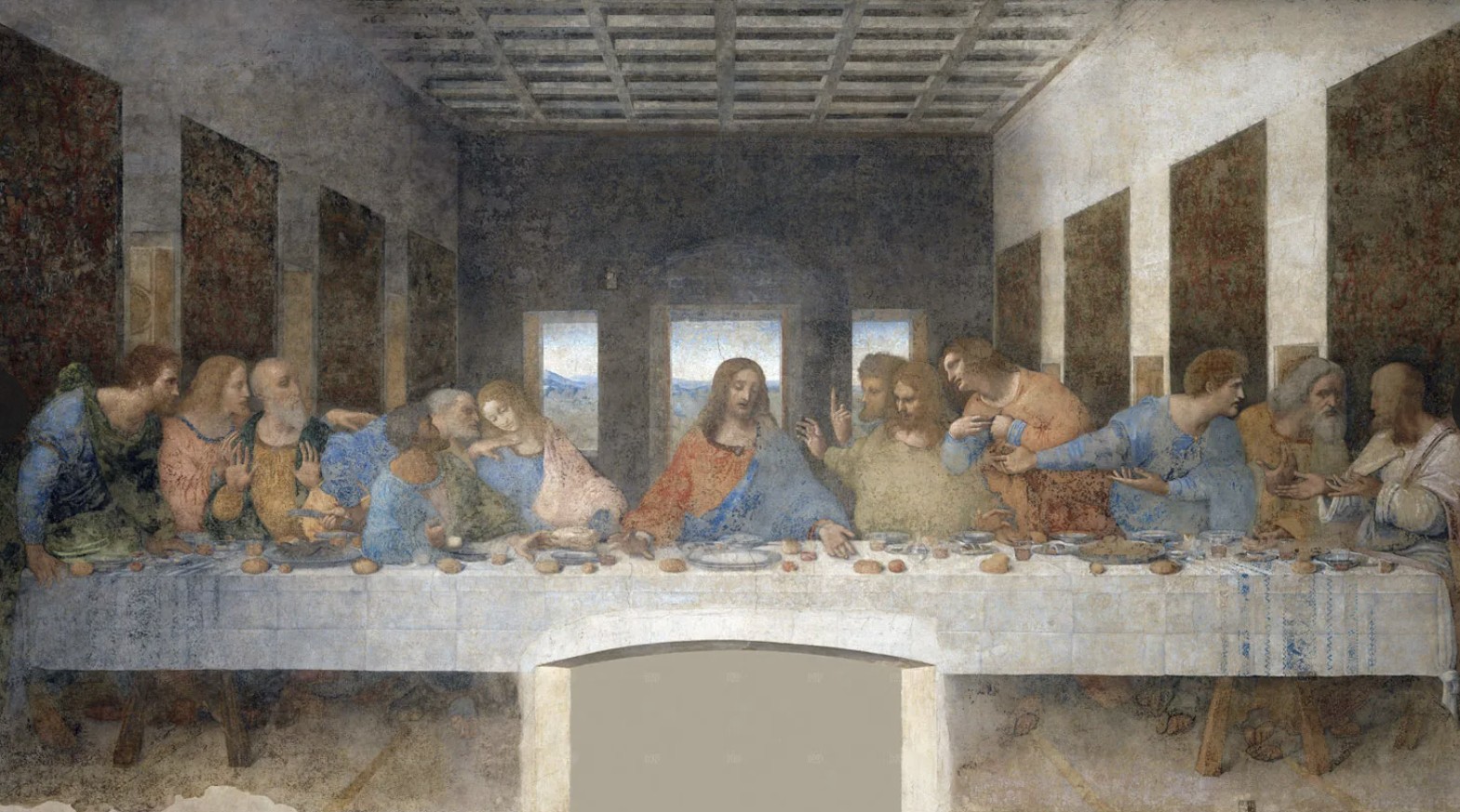
We all know of his masterpieces, acknowledged around the world for centuries now, from the sublimity of Mona’s ever so slight smile to the compositional brilliance of his “Last Supper”, to name just two, but I would offer another that only Leonard aficionados will likely know of. And here I will go on record saying this painting reveals more of his true genius than all those hanging in museums around the globe. The reason few people will know of it because da Vinci left it unfinished, leaving it little more than a working draft.
We don’t know why he walked away from it, but was likely due from simple distraction. From the notebooks he left behind we can clearly see that his artistic talents were far from his only passion, and because of that multiplicity of interests, he completed very few pieces in his lifetime. In fact, he likely considered painting as a necessary distraction from his true passion for nature, science, and engineering. Painting paid the bills, in other words, and it’s easy to notice from several of his works that at times his heart just wasn’t fully committed. He accepted the commissions, of course, but there are several that he left unfinished, such as another potential masterpiece, “The Adoration of the Magi.” I don’t believe they were not abandoned with any bad intentions, but rather due to being consumed by his other passions. His mind was an unrelenting machine of curiosity and was evidently powerless to control the pyrotechnics exploding across his mind. The man was insatiably curious and possessed the greatest creative mind that Western Culture had ever seen at that point, with a deep passion to understand how everything worked. His notebooks are filled with studies of Botany, fossils, birds, the human heart, geology, flying machines, hydrodynamics, physiology, architecture, and weaponry. We tend to group “artists” into one large homogenous genre, but da Vinci could never be contained within a single category. He had many other kettles on the burner.
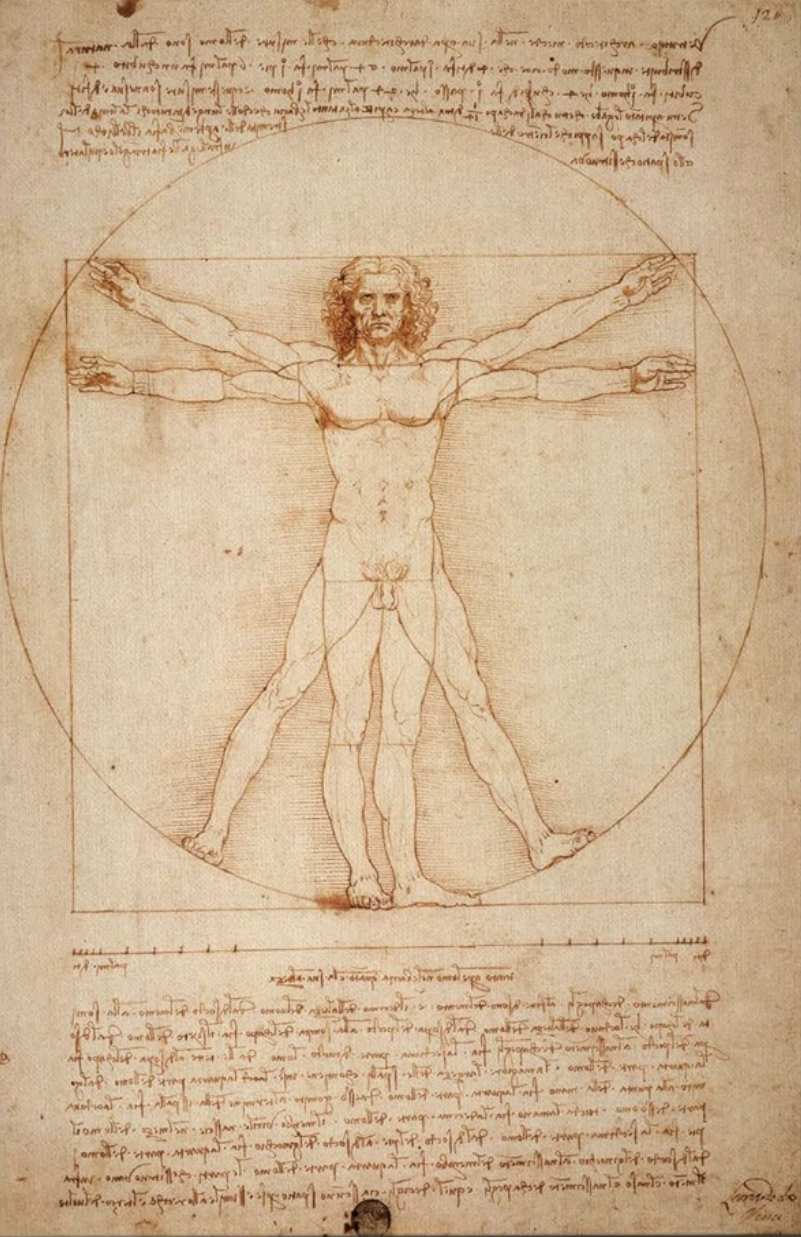
He first caught my attention in serious way in my twenties, and I quickly became fascinated by his mind. Whether it was his interpretation of the “Last Supper”, or the symmetry of his “Vitruvian Man”, or his various drawings of the human anatomy, all of it launched me into a profound reverence to the mind behind the pen. I admired other Renaissance artists, certainly, for who couldn’t admire Michelangelo’s skill with hammer and chisel, or Raphael’s sublime brushwork, but with da Vinci there was so much more than art. He left thousands of pages of notes and drawings that revealed his obsession with ideas of all kinds. He was the world’s first polymath, the true Renaissance Man, with interests covering most every field imaginable, from inventing musical instruments to machines of war, and nearly everything in between.
But all that is just background chatter to my intentions here, which is to showcase the first truly emotional painting in the history of art, which I believe is Leonardo’s “St. Jerome.” Because most people will have never have heard of it, that claim will sound like some delirious fanboy, but please stay with me. I understand there are other paintings from the period that are considered emotional, but I will argue they are only subjectively emotional. Meaning that in each and every example, the emotional export of the piece came from the theme alone, such as Jesus on the cross, or the severed head of John the Baptist, or the Virgin Mary with child. There were certainly admirers of the paintings, people who were emotionally moved by the vision, and they may have even wet their pants at the sight of them, but it was only due to the context. And the proof can be readily seen spread across dozens, if not hundreds of canvases. As you’ll see, the concept of producing emotional expressions was simply not part of their milieu.
To prove my case on that point, it’ll be necessary to take a look at a few of those competitors, da Vinci’s peers, which will include the best 15th century painters Europe had to offer, who like himself, were also commissioned by Popes and Kings to bring the Bible narratives to life.
I was about to suggest that we “buckle up” before witnessing the veracity of their efforts, but I found myself smirking at the idea. What is clearly evident from their paintings is one undeniable fact, that regardless of their mastery with a brush or their compositional strengths, what screams out from the rafters was a complete lack of conveying emotions, even within scenes that should exude emotional depth. I will not take up unnecessary room here displaying dozens of examples, but rather a small handful. Though trust me, feel free to search the best 15th century painters for yourself, for they will all exhibit the same vacant expressions.
Giovanni Bellini (1485)

Sandro Botticelli (1482)

Domenico Ghirlandiao (1485)

Hans Memling (1489)

Do you see my point? Regardless of their technical prowess with the medium, their subjects consistently lacked emotional expressions of any kind, and they very often used the same faces for multiple people in the composition.
Of course, we must remember that da Vinci was still a man of his times, as brilliant as he was, and had also been trained to paint in the same style as all the others, so several of his early paintings exhibit a similar emotional restraint. But with St. Jerome, with his growing artistic maturity beginning to unfurl, he soared far beyond his contemporaries and landed in the realm of unmistakable genius, and no other painting, finished or not, showcases the gulf between himself and his peers more than St. Jerome.
To truly witness the creative leap this painting represents, we also need to consider the earlier paintings of St. Jerome (below), which I find comically unaffecting, as if the best artists in Europe could only imagine Jerome as a respected Saint and disciple of the faith, stoically sitting in his study, dressed in his Cardinal attire pondering ‘God’s word’, with the ever-present Lion laying at his feet. As the story goes, St. Jerome reportedly removed a splinter from a Lion’s paw (must have been a Lion ‘Cub’), thus the inclusion of the Lion represents Jerome’s compassion for others over himself. But please study these closely and notice how little they convey emotionally. Anemic is the unavoidable word that comes to mind, to the point of absurdity. In these examples, St. Jerome is nothing more than a stage prop, inserted into the painting no differently than his chair, table, or bookshelf.

But da Vinci would have none of that. The intellectual muscle and imagination he had at his command rejected such pedestrian interpretations and instead turned Vatican tradition on its head by reimagining an entirely different concept. He went nuclear, in other words, and completely rejected the orthodox, scholarly tradition of a respected Jerome dutifully studying his bible.
Da Vinci very likely knew of these earlier paintings and probably thought to himself, ‘to hell with all that’ and stripped his St. Jerome of all pretenses, as well as most of his clothing, and placed him living in the wilderness, beating his chest with a stone in penance at the suffering Jesus. Even da Vinci’s Lion appears fully engaged and doesn’t sit passively at Jerome’s feet like some child’s stuffed animal.
Just take a moment and look deeply at the pathos da Vinci imagined for his St. Jerome, full of anguish and pity, then step back and gasp at the juxtaposition between this unfinished, would-be masterpiece against the efforts of his contemporaries.

As mentioned, we have no idea why he left a painting so full of potential unfinished, for he surely recognized the vein of creative gold he had tapped into. Just imagine if he had given it his full concentrated attention and painted Jerome with the same realism, the same nuance that he produced in his finished works. If he had, the modern world would not consider Mona’s faint smile his masterpiece, but rather Jerome’s anguish. From the records left behind there are no known commissions for the painting, so scholars believe it may have been intended as a private devotional painting that he imagined purely for himself, or perhaps it was simply an idea he had in his head. Perhaps he captured enough of it to satisfy himself and that was enough. Whatever the reason for its abandonment, it nonetheless represents a profoundly missed opportunity for the art world.
Yet, I am still left with the question of its inspiration, for St. Jerome was a substantial leap forward, even for himself, because none of his earlier efforts hinted at such a visceral expression. I believe any attempt to answer that question will necessarily bring us to the doorstep of what separated him from all the other artists of his day, and that would be his obsession with human physiology, which drove him to study it like a scientist, to the point of dissecting cadavers in order to understand how joints, tendons and muscle functioned beneath the flesh, then drew his finding in his notebooks. Below is one such entry that appears to be an inspiration for his St. Jerome, for it captures a very similar face, lean and weathered, with the same straining neck muscles and tendons that da Vinci wanted to exploit.

Before signing off on this little digression of mine, I want to provide this closeup of St. Jerome’s expression in order to remind us of what da Vinci ultimately denied us. As suggested earlier, just imagine this expression being given the same nuanced treatment he gave to the “Mona Lisa”, with his eyes glistening with tears, and realize that da Vinci was operating on an entirely different level. Others would learn and adopt from him, of course, but at this point in the game, he was the untouchable master, the man who completely reimagined how to present authentic human drama into art, which by definition suggests he was the most human of them all.
