The Midnight Library and the Paradox of Choice

I’ve been an avid reader for well over forty years now and across that time I have covered quite an eclectic group of authors, from the mental archeology of Dostoyevsky to the wild existential pursuits of Tom Robbins, and most everything in between. And through them all I could always detect a particular thread weaving through their narratives, a theme the authors were attempting to mine, as experienced through the characters and plots they create. It doesn’t matter whether the idea is expressed in a short story, such as Kurt Vonnegut’s “Harrison Bergeron”, or a 900-page tome of dense storytelling such as Tolstoy’s “Anna Karenina”, it will still boil down to a single idea or theme the author hopes to explore for his audience.
With that theme in mind, I just finished a uniquely thought-provoking book titled “The Midnight Library” by Matt Haig, suggested by my lovely daughter (in-law), Morgan, another lover of words and books. Haig’s book posed a simple question that we have all contemplated at some point in our lives, most often when situations aren’t going quite so well and we flirt with the temptation of imagining whether we were meant to live another life.
That is the proposition “The Midnight Library” offers us, as the book’s protagonist, Nora, attempts to kill herself at the outset of the story because she felt there was no point in carrying on with the life she had. But as she hovered between life and death, she mysteriously entered the “Midnight Library” that was filled with thousands of books, each containing an alternative life she could have lived had she made different choices along the way. During this twilight state between life and death, she could open any book in the library and be thrown into that potential life as if it had always existed. Yet with each life she experienced, regardless of the success it offered, a theme of regret still remained at the core of each of them. She soon experienced and began to understand how even a single, innocuous choice often comes with an array of unpredictable downstream effects.
I won’t concentrate on Haig’s book here or Nora’s story, but rather to the implications it presents for each person reading it, because Nora’s confrontation with her alternative lives is meant to reflect back to our own, and thus expose the same dilemma of choices and their cascading consequences. Haig’s invitation is that we will imagine how our own “other lives” may have played out had we made different decisions or if we allowed, or removed particular people in or out of our lives along the way.
The German philosopher, Author Schopenhauer, wrote about this odd paradox, saying that as we age, we often come to believe that our lives unfolded in a natural progression and feel that we have ended up becoming the person we were always meant to be. But the paradox is exposed when we recognize how absolutely random it all felt as we were living it. Different parents, siblings, friends, schools, or cities would all have resulted in different choices being made, creating a multitude of different versions of who I would be now. Schopenhauer was absolutely correct by suggesting that time has a way of paving over the potholes that got us here, to the point that we eventually incorporate our poor choices into the story we tell ourselves as if they were necessary elements all along.
For example, how would my life have unfolded had Kevin Dennis not entered it in high school, or if we had moved out of East Nashville earlier, and away from those bad influences? Or what would have happened if that metro police officer had chosen to pull me over in front of the Sander’s house instead of driving on? Or if my dad had focused on teaching me discipline and focus instead of leaving me to my own vices.
To that last point, let me say that it was precisely during my teenage years, when all my potential was sitting ready on the launchpad, that instead of having strong parental guidance making sure that I focused on excelling, I had instead a blank check to do whatever I wished, without the threat of punishment. When I needed a firm hand the most, I had nothing in the form of corrective actions, no “tough love” moments to cut through my immaturity, no “come-to-Jesus” confrontation that forced a reset of my priorities, which effectively removed the guardrails I needed to kept my life on the road and out of the ditch, which is where I soon found myself.
When I deeply consider Haig’s book and imagine the various lives that I could have lived, there is one potential life that remains stuck in my throat as a constant reminder of “what if”….. and that is my brief time as a collegiate-athlete. Even after 40 plus years, I still occasionally wonder what would have happened had I arrived on the MTSU campus with purpose and focus, with maturity and a drive to excel, not only as an athlete, but as a student?
The actual “athlete” piece to that unfolding disaster wasn’t the issue, as my freshman year was very promising. I was the only freshman on the team to earn a spot in the starting lineup and even batted 2nd in the lineup, which meant the coaches knew I could produce….even as a skinny, 18-year-old freshman, much like my freshman year in high school when I earned the starting spot over a senior 2nd baseman, David Neighbors, and even earned the spot of lead-off batter. I had a lot of natural talent, and anyone who watched me play knew it.
Much of that year is a blur to me now, being 45 years and another lifetime ago, but for me it all culminates with the best game of my life against LSU in Baton Rouge. Our team had traveled to Southern Louisiana that Spring and stayed on the LSU campus while we played against other colleges in the area. Our week-long stay culminated with us playing a night game against LSU on our final day, and since they were in the SEC, a league superior to the Ohio Valley Conference (OVC) that we were part of, it was a big deal. I remember being in awe at that level of talent they had, but I don’t recall feeling intimidated at all. I was too naive to even think in those terms.
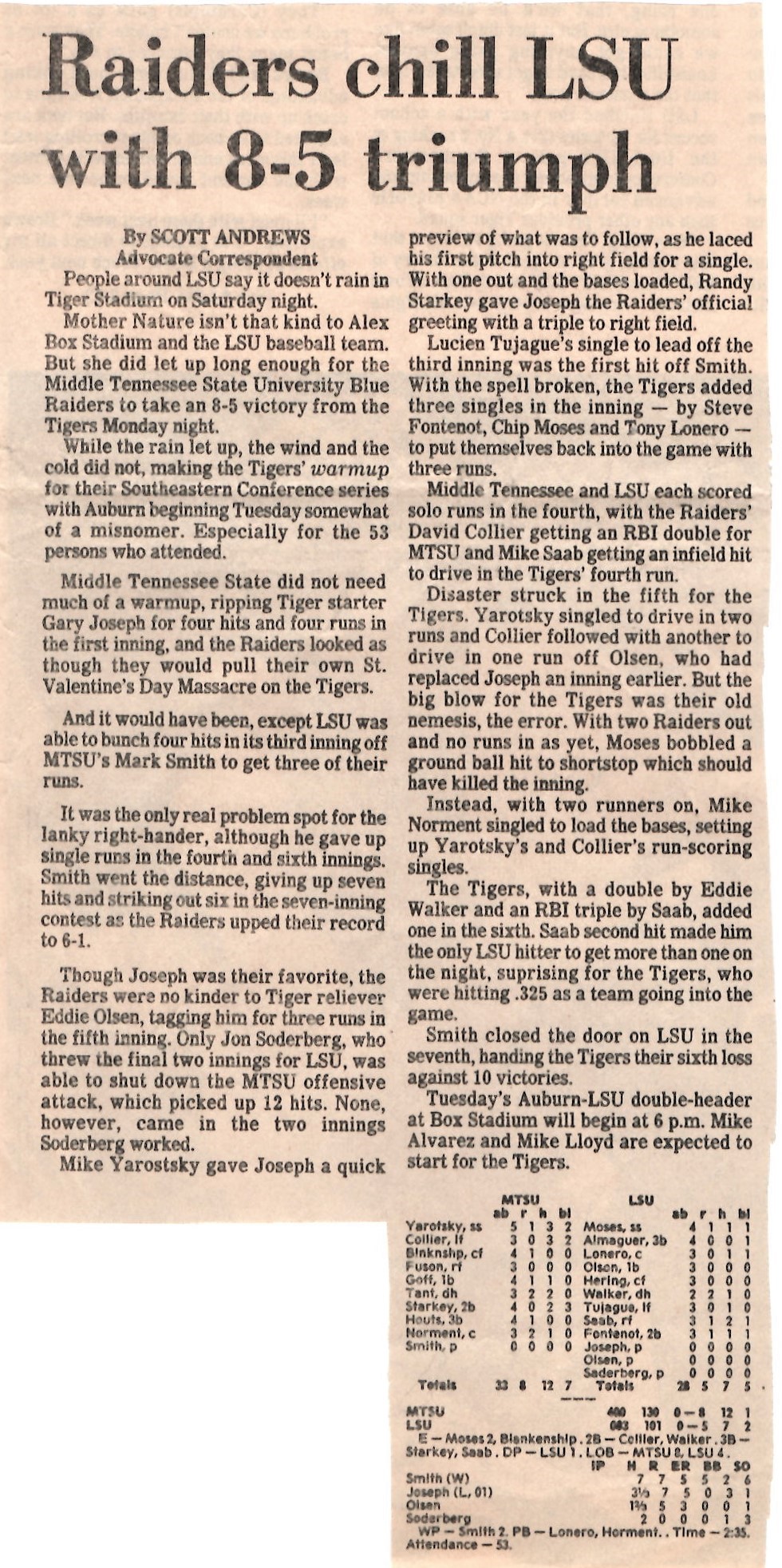
The game began like a cannon shot with our shortstop, Carl Yarostski lacing a line drive single on the very first pitch, announcing that LSU should buckle up for a rough ride. Then I followed with another line-drive single to right-center, and from there we kept the peddle down. I finished the game going 3 for 3, with 2 singles, a double, all line drives, and two RBIs, and we beat them 8 to 5.
Below is the only photo that exists of me actually playing in a game, and fortuitously enough, it captures me in mid-swing at my athletic peak. If only a single picture were allowed to capture me as a player, this would be the one I would want. The photo was taken against Belmont University during a spring game in 1980, and I must say, the form looks good, feet planted, hips rotated, belt-buckle pointing to the field I intended to hit the ball with head down and focused.

A key piece to this story is that our assistant coach, Carmen Fusco, was also a professional scout, and after watching me cluelessly fumbling around the first two weeks of Fall practice, he apparently saw something of interest and approached me. Quite simply, he walked up and asked what the hell I was doing, and wanted to know if I was serious about being a ball player, and if I did, he would personally work with me every day after practice.
Well, that changed everything, and I responded immediately, moving from 3rd string to the starting lineup inside of two weeks of his instructions. For the very first time in my life, I had someone actually teaching me how to play and I blossomed as a player because of it. It was during that freshman year that he told me that he would see to it that I would be drafted if I kept progressing, like others on our team would eventually be, such as Mark Smith, Mike Norment, and my fellow freshman and friend, Kenny Gerhart.
And that is precisely where the sharp edge of regret draws first blood. I lost my scholarship the next year due to academics, or lack thereof (refer to the lack of “guardrails” mentioned above) and my baseball career never recovered. As a result, the life that I was living two years after this photo was taken resembled nothing like the life that was laid out before me there in 1980. To emphasize just how deeply that regret stung, for many years afterward I felt that whenever I died, I wanted my cremated ashes to be spread across the outfield of the MTSU field, because it felt that I had lost something so deeply innate, so primal that the only closure that felt appropriate was to become a part of that field.
But as visceral as that sounds, it comes with something of a twist, a caveat that changes the framing of any potential life that may have played out had I remained at MTSU. Simply put, I met Debbie in the fall of my sophomore year and had I remained and progressed as Coach Fusco felt I would, a different life would have been lived, and the odds that Debbie and I would have remained together through three more years of college and a professional baseball career, even if that only meant a short stint in the Minor Leagues, would not have carried attractive odds.
And that is where the whole discussion of regrets comes to a resounding halt. Had Debbie and I fallen to the wayside, I would not have Scott, and that ends the debate for me. Full stop. Whatever potential baseball career laid in store for me, whatever other life experiences may have played out with other girlfriends, and other opportunities; the realization that I wouldn’t have Scott means that I wouldn’t want any part of it. Even at the thought of fulfilling my dream of being a professional baseball player, at whatever level that may have been, it would mean nothing next to the life I experienced as his Dad.
Allow me to be clear on that point, because I certainly understand that had I lived another life, I would have had another kid, or even several of them, children that I would surely loved without any doubt. But that isn’t my point. The point is that I had Scott, specifically. To understand that distinction, realize that I’ve spent a lifetime as an art lover and have a deep appreciation of aesthetics, meaning that I can often see “the life behind things”, which I wrote about in another essay. That is to say that I have a deep need to see beneath the surface, to see and understand the core of a thing, be that song lyrics, a painting, a perfectly executed scene from a movie, a social movement, or just a single person, and with Scott I could see a diamond. And I am not using that as a casual metaphor, but rather something closer to literal, because diamonds are pure, the purest form of carbon we know of, and with Scott, I saw the purest form of childhood goodness. I loved him to be sure, but the “full-stop” I feel today regarding my past regrets is due to the pureness of that little boy, who then grew up to be an amazing young man, his character, integrity, honesty and his sense of honor….I truly believe the world is a better place because he is in it, and whatever price the gods required of me to have him here, I would gladly pay over and over and over again.
So, there you can see the paradox, as it presents itself to me. From Haig’s implicit invitation I took a stroll through a key book from my own Midnight Library and imagined an alternative life that I had always dreamed of, but quickly came face-to-face with my own paradox of choice, because my biggest regret led to my greatest joy.
My eyes caught a poignant quote from the book that succinctly echoes that sentiment by stating what we all easily forget in the rush and fog of living.
“We can choose choices but not outcomes.”
That line conveys so much more than seven words should be capable of, for we have all been kicked around at some point along the way, by others, by life in general, or more often by our own mistakes and misjudgments. With that in mind, I want to end this note with an encouraging reminder that when making decisions, we should be considerate to our futures selves.